Buransh: The Himalayan Botanical That Is Changing Indian Skincare
Why Uttarakhand's state flower may be the most powerful indigenous brightening ingredient available
The Science Behind the Flower
Rhododendron arboreum (Buransh) grows at altitudes between 1,500–3,600 metres in the Himalayan ranges of Uttarakhand, Himachal Pradesh, and northeastern India. The flower has adapted over millennia to survive intense UV radiation and oxidative stress at altitude — and that survival mechanism is encoded in its chemistry.
The primary active compounds in Buransh are anthocyanins (particularly cyanidin-3-glucoside and petunidin-3-glucoside), ellagic acid, gallic acid, and quercetin. Each plays a distinct role in the skin:
- Anthocyanins are powerful free-radical scavengers that neutralise ROS (reactive oxygen species) generated by UV, pollution, and metabolic processes — all major triggers of post-inflammatory hyperpigmentation.
- Ellagic acid has been demonstrated in multiple peer-reviewed studies to inhibit tyrosinase — the enzyme responsible for melanin synthesis — at concentrations as low as 0.5%. This is a gentler, more targeted mechanism than hydroquinone or kojic acid.
- Gallic acid provides additional antioxidant protection and mild keratolytic activity that accelerates the natural exfoliation of pigmented surface cells.
Why It Matters for Indian Skin
Hyperpigmentation is the number one reported skincare concern among people with Fitzpatrick IV–VI skin tones — which describes the majority of the Indian population. The causes are multifactorial: UV-induced melanogenesis is compounded by hormonal triggers (melasma), post-inflammatory hyperpigmentation from acne, and pollution-driven oxidative stress.
Most brightening actives available in the Indian market were developed for Caucasian skin types and tested primarily on lighter Fitzpatrick types. Buransh's mechanism of action — antioxidant-driven and tyrosinase-inhibiting — works regardless of baseline melanin levels, making it inherently suited to deeper skin tones where brightening must be precise and controlled rather than blanket.
Our Sourcing & Stability Process
VEYLOR sources Rhodiola Extract from a cooperatively managed harvesting programme in Uttarakhand, working with local communities using sustainable wildcrafting practices. The fresh flowers are processed within 48 hours of harvest to preserve polyphenol integrity, then standardised to a consistent anthocyanin concentration before being incorporated into our formulations.
Stabilising polyphenols in an aqueous serum base without oxidation was the central formulation challenge we spent 14 months solving. The solution was a dual-encapsulation approach combined with a precisely calibrated pH buffer that keeps the extract active while preventing discolouration.
How We Use It
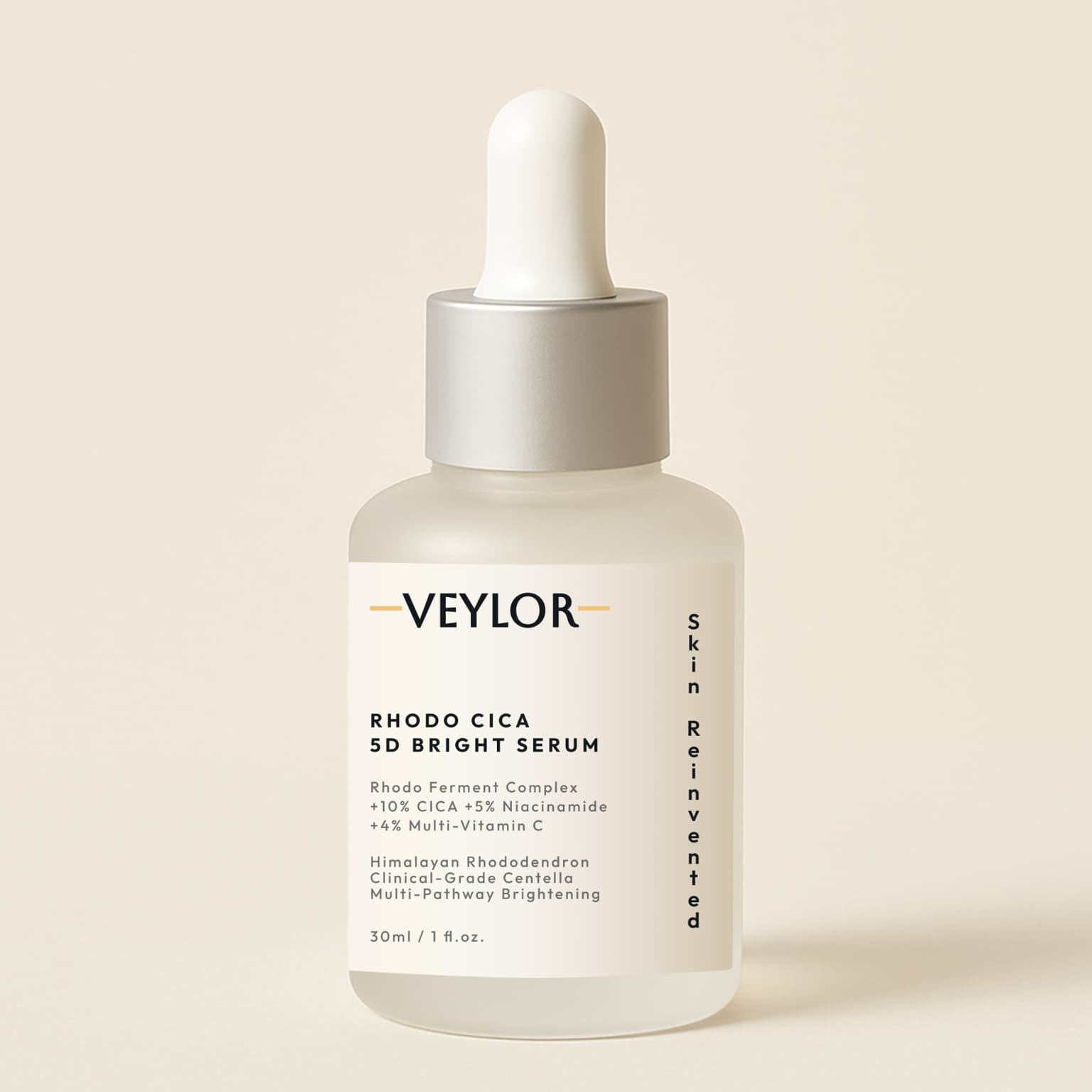
The Rhodo Cica 5D Bright Serum contains Rhodiola Extract at 2% — the minimum concentration we found effective in internal trials. It is paired with 10% Niacinamide (which addresses melanin transfer rather than synthesis), and 3% Tranexamic Acid (which works at the plasmin-melanocyte stimulation level). Together, the three actives address pigmentation at three distinct points in the melanogenesis pathway, making the combination more effective than any single ingredient used alone.
Dr. Priya Sharma
Consultant Dermatologist, Mumbai
Join 12,000+ skincare-conscious Indians
Get formulation insights, expert routine guidance, and early access to new launches. Curated by dermatologists and formulation scientists.